Market Brief October 2026
Photographic Cutout Assets: A Small Market Inside a Very Large Visual Economy
Photographic cutout assets sit in an unusually specific corner of the creative market: real photographs of objects, people, food, plants, or other subjects that have been isolated from their original backgrounds and prepared for reuse in design.
There is no reliable public estimate for this niche on its own. The available evidence instead comes from the markets around it: stock photography, creative-asset subscriptions, digital design tools, craft and creator platforms, and paid advertising benchmarks.
Those surrounding markets are large. The question is not whether visual assets are commercially important—they clearly are—but how much of that activity applies to reusable photographic cutouts specifically.
broader 2026 market
reported range for stock-image and stock-photography markets
still-image share
reported photography or stock-image share in adjacent markets
paid downloads
reported by Shutterstock for 2025
selected CPC range
observed across related search terms
Market size: the closest available benchmarks
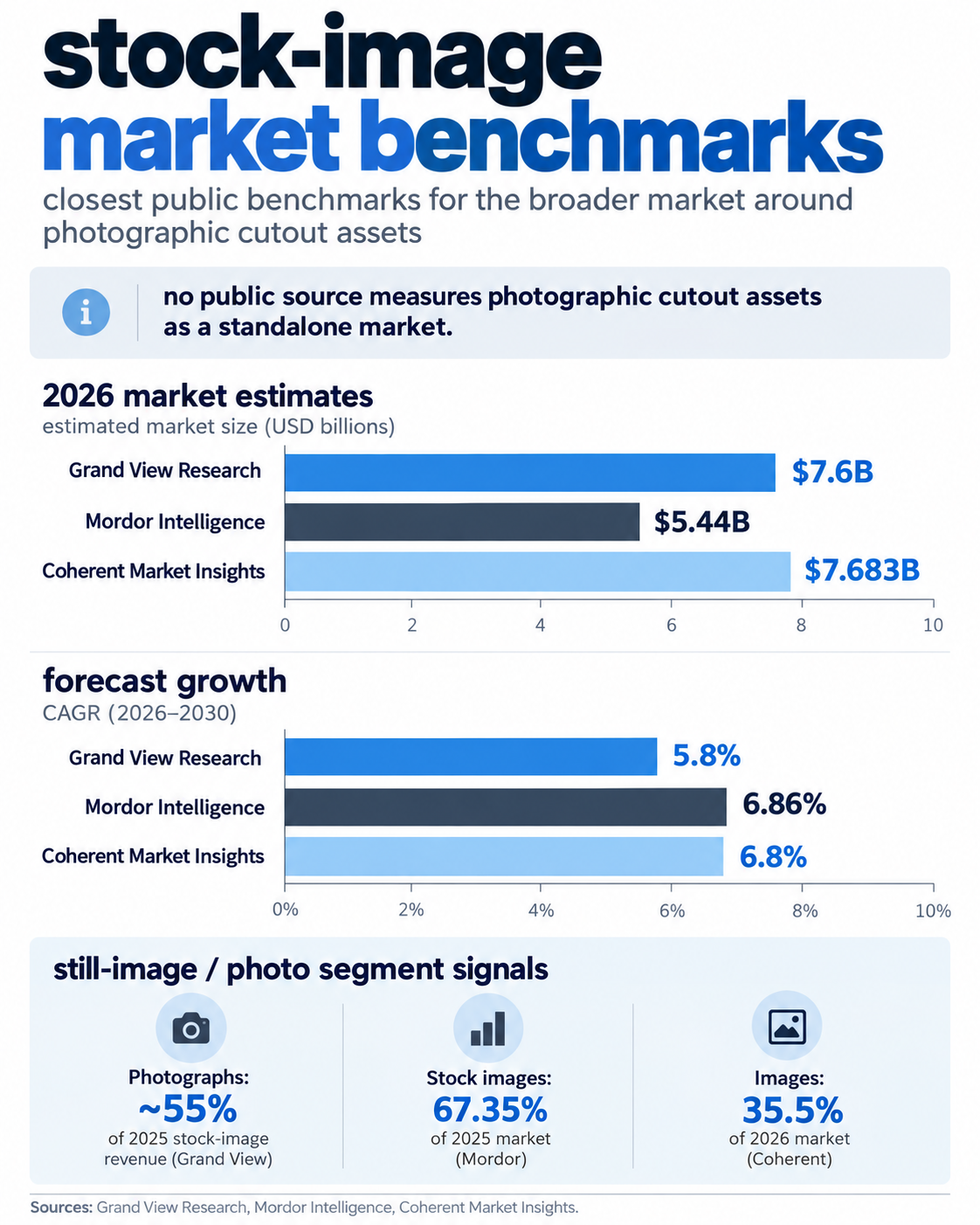
Three major research firms place the broader stock-image and stock-photography market in roughly the same multi-billion-dollar range, although their definitions differ.
| Source | 2026 estimate | Forecast | CAGR |
|---|---|---|---|
| Grand View Research — Stock Images | $7.6B | $12.7B by 2035 | 5.8% |
| Mordor Intelligence — Stock Photography | $5.44B | $7.58B by 2031 | 6.86% |
| Coherent Market Insights — Stock Photography | $7.683B | $12.176B by 2033 | 6.8% |
The reported 2026 range is therefore approximately $5.44 billion to $7.68 billion.
These figures should not be averaged into a single market estimate. Each source defines the category differently, and several include more than still photography—such as vectors, illustrations, video, AI-generated imagery, or audio.
Even so, photographs and still images remain major components of the broader market. Grand View Research reports photographs at about 55% of 2025 stock-image revenue, while Mordor reports stock images at 67.35% of its 2025 market. Coherent Market Insights reports its broader “images” segment at 35.5% of 2026 market value.
Using Grand View Research’s figures, the photograph segment alone implies roughly $3.96 billion in 2025 revenue. Mordor reports $3.43 billion for its stock-images segment.
Commercial use remains central
The surrounding stock-content market is heavily commercial.
Mordor Intelligence reports that 57.55% of 2025 market revenue came from commercial campaigns and forecasts that application category to grow at 8.12% CAGR. Advertising and marketing agencies also represent a substantial buyer group: Grand View Research places agencies at approximately 38% of 2025 stock-image revenue, while Mordor reports 34.08%.
Royalty-free licensing is also a dominant model. Grand View Research estimates royalty-free content at about 48% of 2025 stock-image revenue. Mordor puts royalty-free structures at 71.65% of turnover, representing approximately $3.65 billion.
That matters for photographic cutouts because their natural use cases—advertising, social media, websites, ecommerce listings, packaging, presentations, editorial layouts, and branded content—fit comfortably inside the same commercial licensing environment.
Large platforms show the scale of paid visual-asset demand
Shutterstock provides one of the clearest public examples of paid activity in the visual-content market.
In 2025, Shutterstock reported:
- $989.9 million in total revenue;
- $786.7 million in content revenue;
- 3.5 million+ customers across more than 150 countries;
- 453.1 million paid downloads;
- 1.032 million subscribers; and
- $281 average revenue per customer over the trailing 12 months.
The platform also reported that its top 25 customers generated less than 20% of revenue.
Other large platforms demonstrate the scale of the asset libraries competing for that demand. Envato Elements advertised 29 million+ creative assets, including 16.6 million+ stock photos, at a starting subscription price of $16.50 per month. Magnific, following Freepik’s 2026 relaunch, reported 1 million+ paid subscribers, 100 million+ monthly visits, and 200 million+ design and stock assets.
For a specialized seller, this means the competitive environment is not limited to other niche cutout shops. Buyers can also choose from huge subscription libraries, stock-photo platforms, design suites, and increasingly AI-assisted creation and editing tools.
The broader design economy is considerably larger
Photographic assets are consumed inside a much larger digital-design environment.
Grand View Research estimates the global digital-content-creation market at $41.1 billion in 2026, with a forecast of $69.8 billion by 2030 and 13.9% CAGR from 2025 through 2030.
That category includes software and services rather than the assets themselves, but it shows how much money is being spent on the systems in which visual assets are created, edited, assembled, and published.
Canva reported 260 million monthly users in 2025 and $3.5 billion in revenue, with usage across small businesses, creators, nonprofits, education, and large companies.
Cricut provides another useful proxy for paid creative participation. As of March 31, 2026, the company reported 5.969 million active users, 3.078 million paid subscribers, and $84.8 million in quarterly platform revenue.
Etsy adds a broader commerce view. The marketplace reported 86.5 million active buyers, 5.6 million active sellers, and $10.461 billion in gross merchandise sales for 2025. Its six largest categories—including craft supplies and paper/party supplies—represented approximately $8.9 billion, or 85% of marketplace GMS.
None of these platforms measures photographic-cutout demand directly. They do, however, establish the scale of the creator, craft, design, and small-business ecosystems in which reusable image assets can be consumed.
What does it cost to reach these audiences?
Paid-media benchmarks provide another way to understand the commercial environment around visual assets.
Search demand and keyword cost
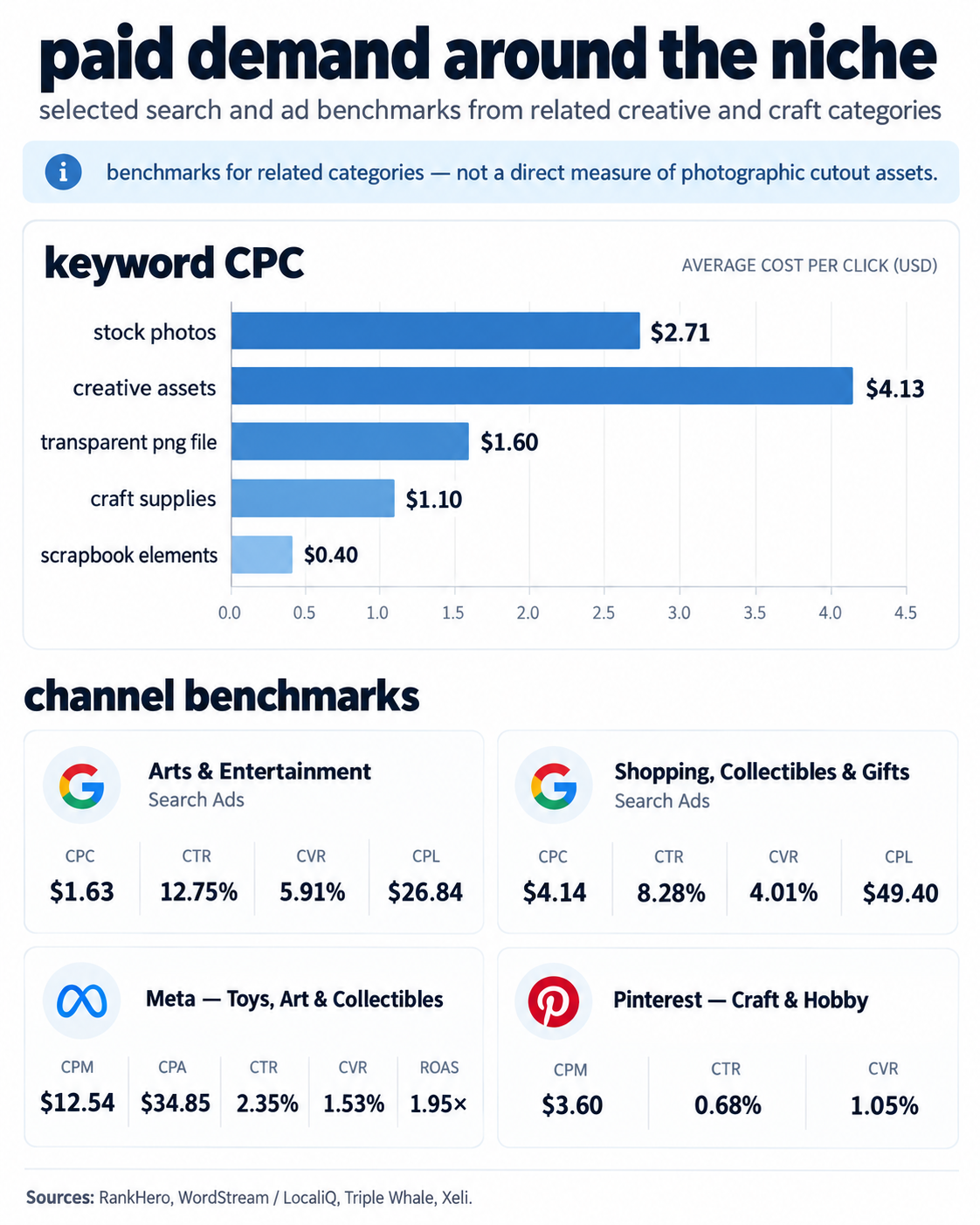
Selected keyword estimates show a wide range of search volume and cost-per-click:
| Search term | Est. monthly searches | CPC |
|---|---|---|
stock photos | 135,000 | $2.71 |
creative assets | 880 | $4.13 |
transparent png file | 390 | $1.60 |
craft supplies | 22,790 | $1.10 |
scrapbook elements | 1,000 | $0.40 |
These figures should be treated as individual search-market observations rather than as one combined audience. The keywords vary substantially in intent and scope.
Broad terms such as stock photos describe the larger parent market. transparent png file is closer to the format itself, while craft supplies and scrapbook elements represent adjacent use cases.
Search-ad benchmarks
WordStream / LocaliQ’s 2026 Google and Microsoft search-ad benchmarks reported:
| Category | Avg. CPC | CTR | CVR | CPL |
|---|---|---|---|---|
| Arts & Entertainment | $1.63 | 12.75% | 5.91% | $26.84 |
| Shopping, Collectibles & Gifts | $4.14 | 8.28% | 4.01% | $49.40 |
| Business Services | $5.87 | 6.10% | 4.85% | $93.69 |
The dataset covered more than 13,000 U.S. search campaigns across 23 industries from April 2025 through March 2026.
Meta ecommerce benchmarks
Triple Whale’s 2026 ecommerce dataset covered more than 40,000 brands on Meta.
| Category | Median CPM | CPA | CTR | CVR | ROAS |
|---|---|---|---|---|---|
| Toys, Art & Collectibles | $12.54 | $34.85 | 2.35% | 1.53% | 1.95× |
| Media & Publishing | $13.63 | $36.60 | 2.48% | 1.51% | 1.13× |
| Business Supplies & Equipment | $13.33 | $37.98 | 1.88% | 1.70% | 2.34× |
| All-industry ecommerce baseline | $15.06 | $38.99 | 2.39% | 1.53% | 1.88× |
Triple Whale’s Google ecommerce benchmark, based on more than 21,000 brands, reported a $25.12 CPA and 3.22× ROAS for Toys, Art & Collectibles, alongside a median $80.04 average order value.
Pinterest’s 2026 Craft & Hobby benchmark reported a $3.60 median CPM, 0.68% CTR, and 1.05% conversion rate for prospecting campaigns.
These figures do not define the economics of photographic cutouts themselves. They establish the advertising environment surrounding creative, craft, ecommerce, and visual-content audiences.
Limitations
A niche without a direct market-size figure
The available data supports a clear distinction.
The broader visual-asset economy is large, paid, international, and still heavily reliant on photography and royalty-free licensing. Creative platforms operate at enormous scale, and adjacent creator and craft ecosystems contain tens or hundreds of millions of users.
What the public data does not provide is a defensible standalone revenue figure, buyer population, transaction count, or growth rate for photographic cutout assets specifically.
That makes photographic cutouts best understood as a specialized product category inside several much larger markets rather than as a separately measured industry.
The strongest evidence is therefore not a single “market size” number. It is the combination of:
- a $5.44B–$7.68B broader stock-content market in 2026;
- multi-billion-dollar still-image segments;
- substantial commercial and agency demand;
- hundreds of millions of paid asset downloads;
- very large creator and design populations; and
- measurable advertising costs around stock photography, creative assets, crafts, and visual commerce.
That combination establishes a real commercial environment. It does not, by itself, establish the size or profitability of the photographic-cutout niche.
Sources
- Grand View Research — Stock Images Market
- Mordor Intelligence — Stock Photography Market
- Coherent Market Insights — Stock Photography Market
- Shutterstock 2025 Form 10-K
- Envato Elements
- Magnific / Freepik company page
- Grand View Research — Digital Content Creation Market
- Canva — 2025 Year in Review
- Cricut Q1 2026 Results
- Etsy 2025 Form 10-K
- RankHero — Stock Photos
- RankHero — Creative Assets
- RankHero — Transparent PNG File
- RankHero — Craft Supplies
- RankHero — Scrapbook Elements
- WordStream / LocaliQ — Google Ads Benchmarks 2026
- WordStream / LocaliQ — Facebook Ads Benchmarks 2026
- Triple Whale — Facebook Ads Benchmarks by Industry
- Triple Whale — Google Ads Benchmarks by Industry
- Xeli — Pinterest Ads Benchmarks by Industry