Market Brief October 2026
Hobby Bookbinding Has a Real Market — Just Not a Cleanly Measured One
Bookbinding looks like the kind of hobby that should be too small to measure.
It is old-fashioned, hands-on, and unusually specific. But the modern version of the hobby sits at the intersection of several much larger markets: books, crafts, collecting, fandom, journaling, and personalized gifts.
The result is a niche with a surprisingly deep spending ladder — from a few dollars for glue or thread to more than $200 for presses, premium tools, or custom-bound books.
There is no credible single number for the size of the hobby bookbinding market. The useful data is scattered across Amazon, Etsy, craft-sector research, social trends, and advertising benchmarks.
Taken together, though, the numbers are enough to show that this is more than a novelty craft.
Etsy listings
for bookbinding supplies and kits
starter kits
common observed range for beginner kits
monthly searches
estimated for “book rebind”
estimated CPC
for “book rebind” in paid search
The market starts cheap, then gets expensive
A beginner can get into bookbinding without much money.
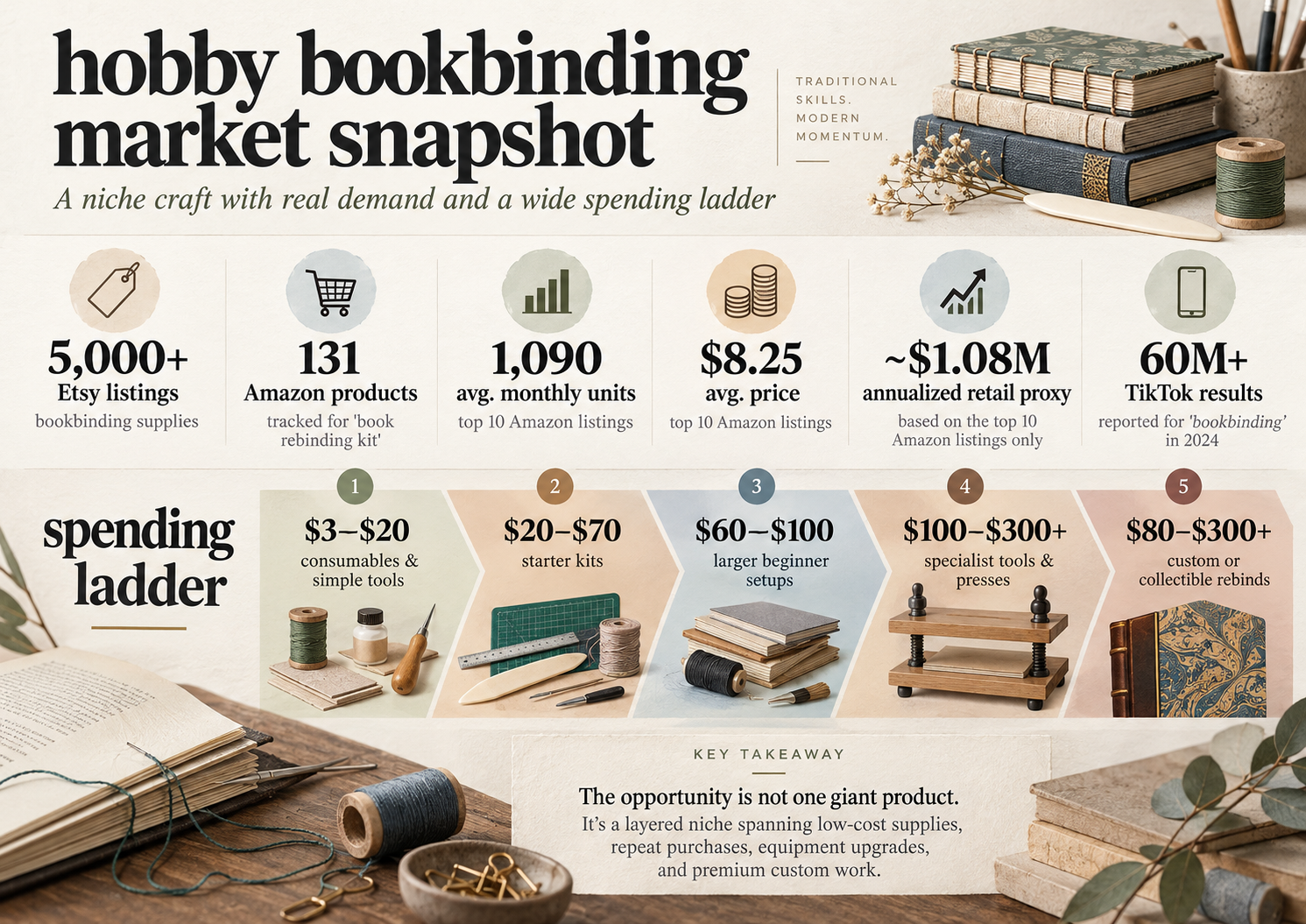
On Etsy, basic bookbinding supplies and simple jigs regularly appear below $20. Starter kits commonly land in the $20 to $70 range, while larger kits and setups can push toward $100.
The same marketplace also has presses and specialist equipment over $100, with some book presses around $120 to $285. Etsy currently shows more than 5,000 listings for bookbinding supplies, covering everything from cloth and awls to punching cradles, presses, thread, boards, and complete beginner kits.
That creates a fairly clear spending ladder:
| Stage | Typical observed price |
|---|---|
| Consumables and simple tools | $3–$20 |
| Starter kits | $20–$70 |
| Larger beginner setups | $60–$100 |
| Specialist tools and presses | $100–$300+ |
| Custom or collectible rebinds | $80–$300+ |
That progression matters more than any single product price.
A person might start with a bone folder, glue, thread, and an inexpensive kit. If the hobby sticks, the next purchases are often better cutting tools, book cloth, rulers, jigs, presses, decorative materials, and replacement consumables.
In other words, bookbinding has both repeat-purchase products and equipment upgrades.
Etsy's current bookbinding-supplies market shows that depth directly.
Amazon shows real volume in the low end of the market
The cleanest Amazon data we found was for the narrower search term “book rebinding kit.”
ASINSIGHT tracked 131 products for that search in July 2026. Its top product was moving roughly 3,000 units per month, while several other directly relevant products were around 1,000 monthly units.
The top results were not exotic equipment. They were basic products such as:
- neutral-pH bookbinding adhesive;
- repair tape;
- bone folders;
- PVA glue; and
- starter tool sets.
ASINSIGHT reported an average of roughly 1,090 monthly units across the top 10 listings, at an average price of $8.25.
If that monthly run rate were maintained for a year, the top 10 alone would represent roughly:
130,800 units per year
and about:
$1.08 million in annualized retail value
That is not the size of the bookbinding market. It is a narrow slice of one Amazon search result.
It does, however, give us a useful floor-level signal: even low-priced rebinding supplies can generate meaningful transaction volume.
ASINSIGHT's book-rebinding report provides the underlying product data.
Custom rebinding is a different market entirely
The economics change quickly when the product stops being glue or a tool and becomes a finished book.
Keyword-research platform RankHero currently estimates about 4,400 average monthly searches for “book rebind.” Its sampled Etsy listings have a median price of roughly $110, with 59% of the observed listings priced above $100.
The actual products are highly varied: personalized hardcover conversions, cloth-bound editions, foil designs, fan-oriented special editions, and fully custom work.
At that price level, the seller is no longer competing in the economics of a $9 bottle of glue.
They are selling labor, design, personalization, craftsmanship, scarcity, and the emotional value of a favorite book.
That is one reason hobby bookbinding is more interesting than the market first appears. It contains both a low-ticket supply business and a high-ticket finished-goods business.
RankHero's “book rebind” data currently places the keyword's median observed listing price around $110.
Social media helped modernize an old craft
Bookbinding is also unusually well suited to short-form video.
The process naturally creates a transformation: remove an ordinary cover, rebuild the book, add cloth or leather, apply foil or vinyl, then reveal the final result.
The Guardian reported in 2024 that a TikTok search for “bookbinding” produced more than 60 million results. It also documented younger hobbyists entering a craft that had historically skewed older, with new binders discovering it through social media and BookTok.
The American Academy of Bookbinding told the paper that introductory courses were filling within hours and that more students were arriving after first learning about binding online.
The Washington Post later reported on the same broader movement, tying DIY rebinding to the growing appetite for elaborate collector editions, custom covers, decorated edges, special endpapers, and other premium physical-book features.
That crossover is important.
Modern hobby bookbinding is not being driven only by traditional book arts. It is also pulling demand from readers who want their favorite books to feel more collectible or personal.
The Guardian and The Washington Post both documented that shift.
What does it cost to advertise into this market?
Public advertising data for bookbinding is scarce, but there are a few useful signals.
A 2024 social-media case study for Bindery Library, which sells at-home bookbinding kits, reported:
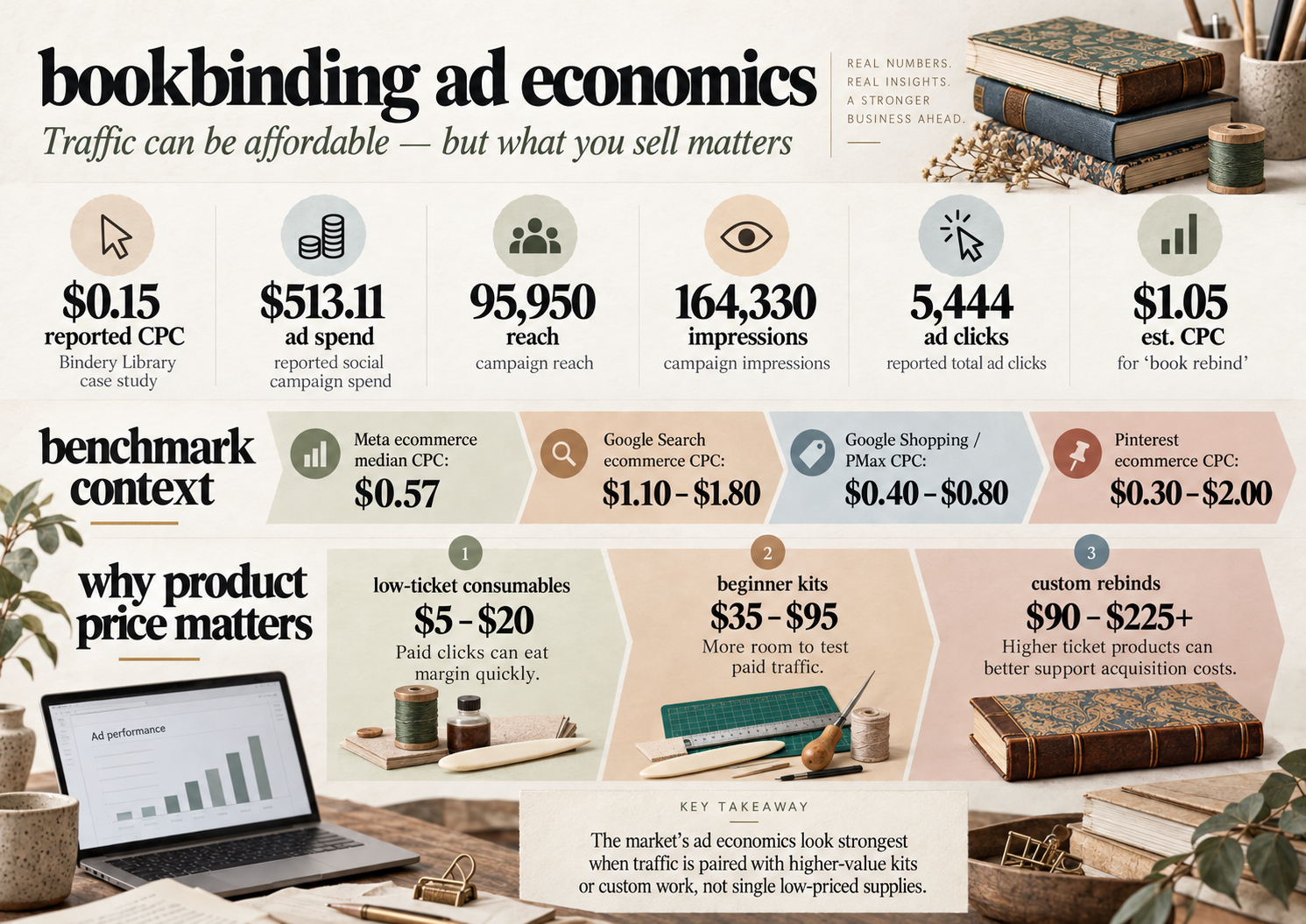
- $513.11 in ad spend
- 95,950 total ad reach
- 164,330 page impressions
- 5,444 total ad clicks
- a reported $0.15 average cost per ad click
That is unusually cheap traffic compared with broad ecommerce benchmarks.
There is an important limitation: the case study did not publish sales, cost per acquisition, conversion rate, or return on ad spend. Cheap clicks are useful, but they do not prove profitable customer acquisition.
The Bindery Library case study is still valuable because directly relevant paid-ad examples in this niche are rare.
Paid-search estimates are more expensive.
RankHero currently estimates:
- $1.05 CPC for “book rebind”
- roughly 4,400 monthly searches
- medium advertiser competition
That number becomes much more interesting when compared with the roughly $110 median observed product price for the same keyword.
A one-dollar click is hard to justify if the product is a $9 bottle of glue.
A one-dollar click is much easier to test when the eventual sale may be worth $100, $150, or $200.
How does that compare with ecommerce generally?
Bookbinding-specific data is too thin to establish a reliable advertising benchmark, so broader ecommerce figures provide useful context.
A 2026 DTC Meta benchmark from Top Growth Marketing reported a median:
- $0.57 CPC
- $13.52 CPM
- 2.68% CTR
- $49.04 cost per purchase
- 2.96x purchase ROAS
The dataset covered 15 brands and about $2.46 million in Meta spend.
A separate ecommerce benchmark from COREPPC places non-branded Google Search CPCs around $1.10 to $1.80, while Google Shopping / Performance Max clicks commonly fall around $0.40 to $0.80.
Those broader ranges make the current $1.05 estimated CPC for “book rebind” look fairly ordinary rather than especially expensive.
The question is less “Are clicks affordable?” and more “What are you selling after the click?”
For a low-margin consumable, the math can get ugly quickly.
For a $50 beginner kit, it becomes more plausible.
For a $100-plus custom rebind, there is considerably more room to experiment.
The bigger craft market is already established
Bookbinding also benefits from living inside a much larger craft economy.
The UK Crafts Council's Market for Craft research found 37.7 million craft buyers across the UK and more than £3 billion in annual craft sales in its 2019 market measurement.
That is not bookbinding revenue, and it should not be presented as such.
It does show that buying handmade work is not a marginal consumer behavior. Bookbinding is a specialist niche operating inside an established market for tools, handmade goods, classes, supplies, and creative experiences.
Crafts Council's Market for Craft provides the broader context.
Conclusion
So how big is hobby bookbinding?
There is not enough clean data to attach a defensible total market value to it.
One broad Amazon keyword report claims more than $18 million in annual sales around “book binding kits,” but its search results are contaminated by unrelated products including jewelry kits, cutting mats, sewing products, office-binding supplies, and other crafts.
Using that figure as the size of hobby bookbinding would overstate the evidence.
The better conclusion is narrower:
Bookbinding is a commercially active micro-market with measurable product demand, thousands of marketplace listings, recurring consumable purchases, higher-ticket tool upgrades, and a premium custom-work segment.
Its economics are also unusually broad for such a small hobby.
The same customer ecosystem supports:
$5 glue → $40 starter kit → $120 press → $200 custom-bound book
That is why the niche is worth watching.
The market may be small compared with broad categories like scrapbooking or general crafts, but it has something those headline market-size numbers can hide: multiple ways for a buyer to spend more as their interest deepens.
Sources
- ASINSIGHT — Book Rebinding Kit
- Etsy — Bookbinding Supplies
- RankHero — Book Rebind
- The Guardian — Bookbinding rejuvenated for the TikTok age
- The Washington Post — Young readers are taking on bookbinding
- Crafts Council — Market for Craft
- Oostas — Bindery Library social-media case study
- Top Growth Marketing — DTC Meta Ads Benchmarks
- COREPPC — Ecommerce Advertising Benchmarks 2026